Steam Deck vs ROG Xbox Ally X vs Legion Go S (2026)
Price rises changed the handheld math in 2026. Specs, current USD and INR prices, SteamOS vs Windows, India availability, and which one fits you.
Updated 29 October 2026. Prices checked the same day on Valve's Steam Deck store and news page, the ASUS US store and Lenovo US, with India prices from launch coverage and retailer listings. Specs come from each maker's official spec pages.
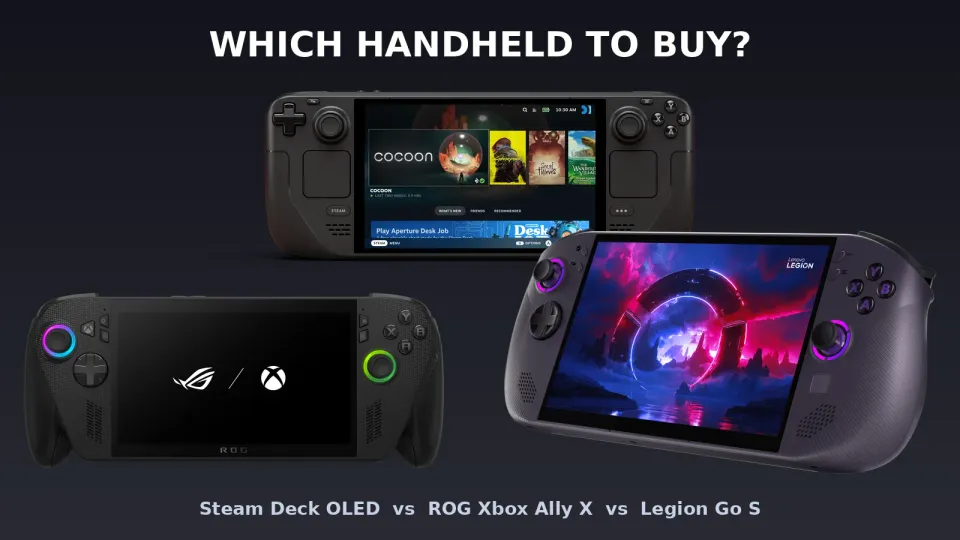
Short answer: if you mostly play your Steam library and want the easiest, most console-like handheld, get the Steam Deck OLED. If you want Game Pass, every PC launcher and the most power of the three, get the ROG Xbox Ally X. The Legion Go S makes sense mainly if you want a bigger 8-inch screen, or if you find the SteamOS version at a good price.
That answer looked very different a year ago. Back then the Steam Deck OLED started at $549 and was the obvious value pick. Memory prices have since pushed all three up, and the gaps between them are smaller than most older comparisons suggest. So I'm going to stick to what each one costs today, what's actually inside, and who each one suits.
Jump to:
- The three in one line each
- Specs side by side
- Prices in 2026 (USD and INR)
- Performance: what the chips tell you
- Screen, battery and weight
- SteamOS vs Windows 11
- Buying in India
- Which one should you buy?
- FAQ
The three in one line each
Steam Deck OLED (Valve). The handheld the others are measured against. It has an older, slower chip, but a gorgeous 7.4-inch HDR OLED screen, SteamOS, and the best-supported game list in the category thanks to Valve's "Verified" program.
ROG Xbox Ally X (ASUS, 2025 model). A Windows 11 handheld built with Microsoft. It boots into a full-screen Xbox interface, runs AMD's newest handheld chip, and has 24GB of RAM, 1TB of storage and the biggest battery here. It also costs the most of the three.
Legion Go S (Lenovo). One handheld with two personalities. You can get it with Windows 11 or with SteamOS, and with either a budget Z2 Go chip or the older but stronger Z1 Extreme. Its selling point is an 8-inch 1920 x 1200 screen with a 120Hz variable refresh rate.
Specs side by side
| Steam Deck OLED | ROG Xbox Ally X | Legion Go S | |
|---|---|---|---|
| Chip | Custom AMD APU, 4 Zen 2 cores, 8 RDNA 2 GPU cores | AMD Ryzen AI Z2 Extreme, 8 cores / 16 threads, 16 RDNA 3.5 GPU cores | AMD Ryzen Z1 Extreme (8 cores) or Z2 Go (4 cores, RDNA 2) |
| RAM | 16GB LPDDR5, 6400 MT/s | 24GB LPDDR5X, 8000 MT/s | 16GB or 32GB LPDDR5X, 6400 MT/s |
| Storage | 512GB or 1TB NVMe | 1TB PCIe 4.0 M.2 2280 | 512GB or 1TB PCIe 4.0 M.2 2242 |
| Screen | 7.4" OLED, 1280 x 800, up to 90Hz, HDR, 1,000 nits peak | 7" IPS, 1920 x 1080, 120Hz, 500 nits, FreeSync Premium | 8" IPS, 1920 x 1200, 120Hz VRR, 500 nits |
| Battery | 50Wh | 80Wh | 55.5Wh |
| Weight | About 640 g | About 715 g | About 740 g |
| Software | SteamOS 3 | Windows 11 Home with Xbox full-screen experience | Windows 11 Home or SteamOS |
| Wireless | Wi-Fi 6E, Bluetooth 5.3 | Wi-Fi 6E, Bluetooth 5.4 | Wi-Fi 6E, Bluetooth 5.3 |
| Ports | 1 x USB-C, microSD | USB4 + USB-C 3.2 Gen 2, UHS-II microSD | 2 x USB4 (USB-C), microSD |
Sources: Steam Deck tech specs, ROG Xbox Ally X spec page, Lenovo PSREF for Legion Go S.
A quick note on that storage row. The Ally X takes a full-size 2280 SSD, which makes upgrading cheap and easy. The Deck and Go S use the shorter 2230 and 2242 sizes. Those are harder to find and usually cost more per terabyte. If you're unsure what those numbers mean, my NVMe vs SATA SSD guide covers the basics.
Prices in 2026 (USD and INR)
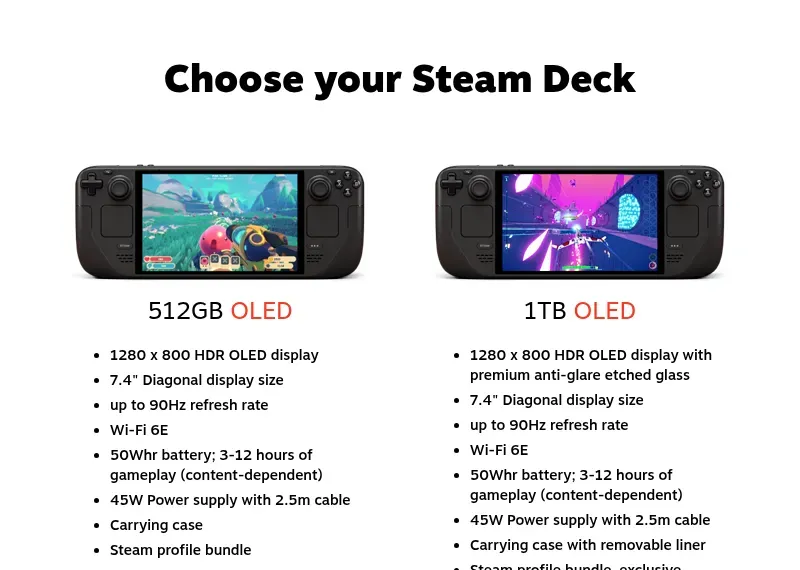
This is the part that has changed the most. In May, Valve raised Steam Deck OLED prices from $549 and $649 to $789 and $949. It blamed memory and storage costs, and it also stopped selling the cheaper LCD model new. Lenovo's prices have moved around even more. In April, the Verge spotted the SteamOS Legion Go S at $1,579.99 at Best Buy, and it's now back near $1,000.
Here's what each one costs in the US right now, with a rough rupee conversion at about ₹95.3 to the dollar so you can compare. Actual Indian prices are in the next table.
| Model | US price (Oct 2026) | About in INR |
|---|---|---|
| Steam Deck OLED 512GB | $789 | ₹75,200 |
| Steam Deck OLED 1TB | $949 | ₹90,450 |
| ROG Xbox Ally (base, Z2 A, 512GB) | $599.99 | ₹57,200 |
| ROG Xbox Ally X (24GB, 1TB) | $999.99 | ₹95,300 |
| ROG Xbox Ally X20 (OLED, new) | $1,299.99 | ₹1,23,900 |
| Legion Go S, Z2 Go, SteamOS | $699.99 (mid-Oct, often out of stock) | ₹66,700 |
| Legion Go S, Z1 Extreme, SteamOS | $999.99 | ₹95,300 |
| Legion Go S, Z1 Extreme, Windows | $1,299.99 | ₹1,23,900 |
Sources: Tom's Hardware on the Deck price rise, the ASUS US store, the Verge on the Ally X20 and Lenovo US. Lenovo prices change often, so check before you buy.
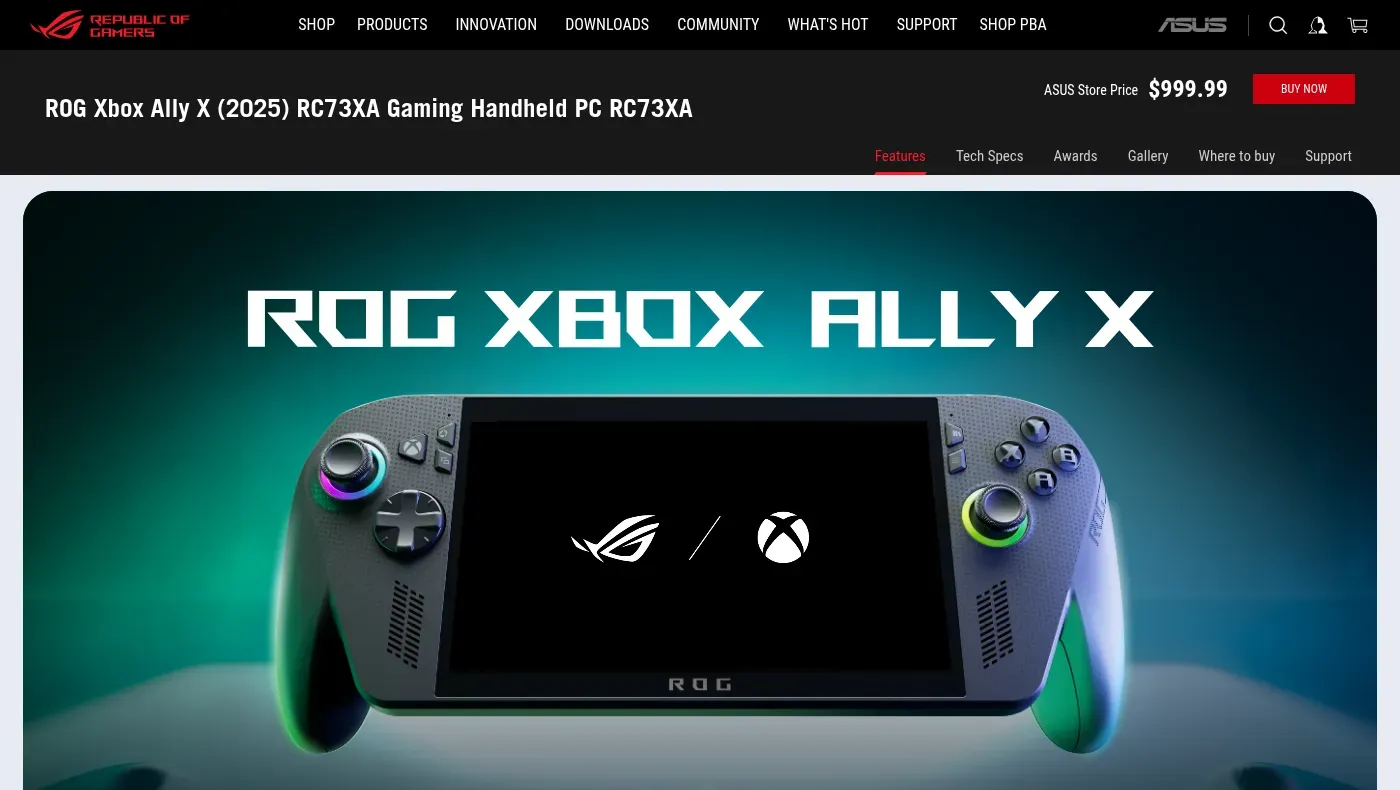
What stands out to me: the 1TB Steam Deck OLED is now $949, while the Ally X with 1TB, 24GB of RAM and a much newer chip is $999.99. That $51 gap used to be $350. So the Deck's value case is weaker than it was. Even so, it's still the cheapest way into a good handheld OLED screen, since the OLED Ally X20 costs $1,299.99.
Performance: what the chips tell you
I haven't run these three side by side, so I won't give you frame-rate numbers I didn't measure. The chips alone tell you a lot, though.
The Steam Deck's APU dates from 2022: four Zen 2 cores, eight RDNA 2 graphics cores and a 15W ceiling. Valve tunes SteamOS and its Verified list around that chip, so older and mid-weight games run well. But the newest big releases often need low settings and upscaling to stay playable. The Deck also renders at 1280 x 800, which helps, because there are fewer pixels to push.
The Ally X's Ryzen AI Z2 Extreme is the newest chip here. It has eight cores and 16 RDNA 3.5 graphics cores, and it can draw much more power when plugged in. Add 24GB of fast LPDDR5X (integrated graphics share system memory) and it's clearly the strongest of the three. It's the one I'd pick if you want to play new releases at higher settings.
The Legion Go S is two machines. The Z1 Extreme version uses the chip from the original ROG Ally and Legion Go: eight Zen 4 cores and 12 RDNA 3 graphics cores. That's well ahead of the Deck and a step behind the Z2 Extreme. The Z2 Go version is a different story. It has four Zen 3+ cores and RDNA 2 graphics, so it's closer to Deck territory, while having to drive a sharper 1920 x 1200 screen. If you're buying a Go S for performance, make sure it says Z1 Extreme.
One more thing: on PC handhelds, online games feel worse when your connection is bad, no matter the chip. If that's your problem, my guide to fixing high ping and lag will help more than a new device.
Screen, battery and weight
Screen. The Deck's OLED is the standout. It has true blacks and HDR peaking at 1,000 nits, but it's only 1280 x 800 and tops out at 90Hz. The Ally X has a sharper 1080p, 120Hz IPS panel with FreeSync Premium, but it's an LCD at 500 nits. The Go S has the biggest panel, 8 inches at 1920 x 1200 with 120Hz VRR, also an IPS LCD at 500 nits. If image quality matters most and you don't want to pay for the X20, the Deck wins. If you want sharpness and size, it's the Go S.
Battery. The Ally X has an 80Wh battery, the largest here by a wide margin. The Go S has 55.5Wh and the Deck 50Wh. Valve quotes 3 to 12 hours for the Deck depending on the game. The Deck's low-power chip helps it stretch that smaller battery, while the faster chips in the other two burn through power quicker when pushed. In short, bigger battery doesn't automatically mean longer play.
Weight. The Deck OLED is about 640 g, the Ally X about 715 g and the Go S about 740 g. None of them are light, but the Deck is the one I'd want to hold for a long flight.
SteamOS vs Windows 11
For a lot of people, this decides it more than the hardware does.
SteamOS (Steam Deck, Legion Go S SteamOS) works like a console. You press a button, it sleeps, you press it again and you're back in your game. Updates are simple, and Valve's Verified badges tell you how well a game runs before you buy it. The downside is that it's built around Steam. Game Pass, games with certain anti-cheat systems and some other launchers either don't work or take extra effort. And if an update goes wrong, you'll need to know how to roll back SteamOS after a black screen.
Windows 11 (Ally X, Legion Go S Windows) runs pretty much everything: Game Pass, Xbox app, Epic, EA, Battle.net, and games with kernel anti-cheat that SteamOS can't run. Microsoft's full-screen Xbox experience on the Ally X makes it far more controller-friendly than plain Windows used to be. You still get Windows' quirks, like updates, driver hiccups and the odd desktop popup.
My rule of thumb: if more than a handful of your must-play games are outside Steam, or you subscribe to Game Pass, go Windows. If your library is almost all Steam, SteamOS is the nicer daily experience.
Buying in India
This is where the three look very different.
| Model | Official in India? | Price |
|---|---|---|
| Steam Deck OLED | No. Grey-market imports only, no Valve warranty | Varies by seller, usually well above the US price |
| ROG Xbox Ally X | Yes, launched October 2025 via ASUS, Amazon, Flipkart and retailers | ₹1,14,990 at launch |
| ROG Xbox Ally (base) | Yes | ₹69,990 at launch |
| Legion Go S | Windows model listed by Lenovo India. The SteamOS version wasn't launched in India | Roughly ₹1,03,000 to ₹1,24,000 on third-party listings, varies |
Sources: IGN India on the Ally launch, India Today.
Valve doesn't sell the Steam Deck in India, so any Deck you buy there is an import. That means you're paying a reseller's markup and getting no official warranty or repair support. For most buyers in India, that makes the ROG Xbox Ally X (or the cheaper base Ally) the sensible choice: official warranty, service centres, and the big online stores stock it.
Which one should you buy?
Buy the Steam Deck OLED if your library is mostly Steam, you care about screen quality and battery life more than raw power, and you live somewhere Valve sells it officially (the US, Canada, the UK, the EU and a few other regions). It's still the most polished, least fussy handheld. Get the 512GB model and add a microSD card rather than paying $160 more for the 1TB model, whose main extras are the storage and an anti-glare etched screen.
Buy the ROG Xbox Ally X if you want the most power, play Game Pass or games from other launchers, or you're in India and want something with a proper warranty. At $999.99 it's no longer much more than a 1TB Deck, and you get more RAM, a much faster chip, a bigger battery and easy SSD upgrades. If you can stretch to $1,299.99, the new Ally X20 adds an OLED screen on top.
Buy the Legion Go S if you specifically want the 8-inch 1200p screen, or you want SteamOS with more power than the Deck and can get the Z1 Extreme SteamOS model near $999.99. Skip the Z2 Go version unless it's heavily discounted, and avoid the $1,299.99 Windows version when the Ally X costs less with a newer chip.
On a tighter budget? The base ROG Xbox Ally at $599.99 (₹69,990 in India) is the cheapest new option of the bunch, with Windows and a 60Wh battery. It's slower than the Ally X, but it's a lot of handheld for the money. Acer's upcoming Predator Atlas 8 is another option worth watching at around $1,300.
Related guides: if you're working through something similar, I've also covered Crimson Desert DLC crashes and Enshrouded crashes and missing saves.
FAQ
Is the Steam Deck OLED still worth buying in 2026?
Yes, if most of your games are on Steam and you value the OLED screen and simple SteamOS experience. At $789 and $949 it's no longer the bargain it was, and the ROG Xbox Ally X at $999.99 is now close in price with far more power.
Which is more powerful, the ROG Xbox Ally X or the Legion Go S?
The ROG Xbox Ally X. Its Ryzen AI Z2 Extreme is newer than the Legion Go S's Z1 Extreme, and it has 24GB of faster LPDDR5X memory. The Z2 Go version of the Legion Go S is much weaker than either.
Can the ROG Xbox Ally X play Steam games?
Yes. It runs Windows 11, so you can install Steam, Epic, EA, Battle.net, the Xbox app and other launchers, and play Game Pass PC games.
Is the Steam Deck sold officially in India?
No. Valve doesn't sell the Steam Deck in India, so units there are imports without Valve's warranty. The ROG Xbox Ally and Ally X are sold officially in India.
Does the Legion Go S come with SteamOS?
Yes, Lenovo sells a SteamOS version, the first officially licensed third-party SteamOS handheld, alongside the Windows 11 version. Availability varies by country, and the SteamOS model wasn't launched in India.
Why did handheld prices go up in 2026?
Rising memory and storage costs. Valve cited those when it raised Steam Deck OLED prices in May 2026, and Legion Go S prices also jumped during the year.
Comments ()