Buy a GPU Now or Wait? 2026 Prices by Tier
GPU prices are still climbing. RTX 50, RX 9000 and Arc prices in USD and INR, what's coming next, and whether to buy now or wait, tier by tier.
Updated: 12 November 2026. US prices from ComputingForGeeks' Amazon tracker (11 November), the videocardprices.com GPU Price Index and TechSpot's Q4 2026 pricing update. Indian prices from gpuprix.com, GPU Tracker and TechSpot's India data.
Short answer: if your current graphics card still runs what you play, wait. If it's dead, or you're building a PC you need now, buy, but buy carefully. Some cards are far more inflated than others. Nothing I can find points to GPU prices dropping soon. They've gone up every month since August, no current card sells within 10% of its launch price on Amazon US, and the next real generation from Nvidia and AMD looks like a 2028 thing.
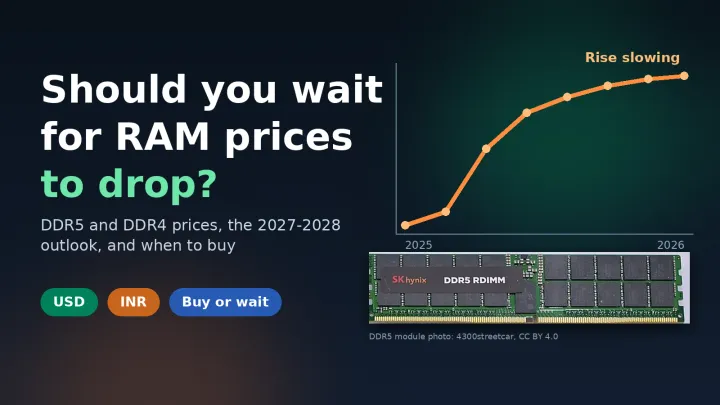
This is the GPU version of the question I answered this morning in should you wait for RAM prices to drop. The cause is the same memory shortage, but graphics cards have their own twists. The 16GB cards got hit much harder than the 8GB ones. And Nvidia's high end has gone a bit mad. So the answer depends a lot on which tier you're shopping in.
Jump to:
- What GPUs cost right now
- Why graphics cards keep getting pricier
- Is anything new worth waiting for?
- Step 1: Check whether your GPU is the problem
- Step 2: Find your tier: buy or wait
- Step 3: If you're buying, dodge the worst markups
- Step 4: If you're waiting, get more from your current card
- My take
- FAQ
What GPUs cost right now
The table below shows the cheapest new card I could find for each GPU against its launch price (MSRP). US prices are the lowest new listings from 11 November where available. Where the trackers disagree, I've given the range. Indian prices are the lowest in-stock listings on Indian price trackers this week, or TechSpot's late-October India figure where a tracker had nothing in stock (marked "Oct"). GST is included.
| GPU | VRAM | Launch price | US now | India now |
|---|---|---|---|---|
| RTX 5060 | 8GB | $299 | $450 to $535 | ₹55,000 to ₹60,000 |
| RTX 5060 Ti 8GB | 8GB | $379 | $530 | ₹56,500 (Oct) |
| RTX 5060 Ti 16GB | 16GB | $429 | $790 to $830 | ₹92,800 (Oct) |
| RTX 5070 | 12GB | $549 | $715 to $900 | ₹1,10,000 |
| RTX 5070 Ti | 16GB | $749 | $1,250 | ₹1,67,000 |
| RTX 5080 | 16GB | $999 | $1,890 to $2,200 | ₹2,10,000 (Oct) |
| RX 9060 XT 8GB | 8GB | $299 | $500 | ₹46,000 (Oct) |
| RX 9060 XT 16GB | 16GB | $349 | $620 to $680 | ₹65,500 (Oct) |
| RX 9070 | 16GB | $549 | $700 to $860 | ₹86,900 |
| RX 9070 XT | 16GB | $599 | $870 to $960 | ₹1,07,500 |
| Arc B580 | 12GB | $249 | $330 to $350 | ₹43,000 (Oct) |
I've left the RTX 5090 out on purpose. TechSpot found the cheapest one in the US at $9,400 in October against a $1,999 launch price. Supply has all but dried up. Unless you make money with that card, forget it exists for now.
Look at the gap between the 8GB and 16GB versions of the same chip. Nvidia launched the two RTX 5060 Ti models $50 apart. On 11 November, Amazon US had them $300 apart: $529.99 for an 8GB MSI card and $829.99 for a 16GB ASUS one. The 8GB card was the only current GPU on ComputingForGeeks' list that actually got cheaper since 30 October. That one detail tells you where the problem is. It's the memory.
India got the same rises a little later. A month ago TechSpot recorded the cheapest RTX 5070 in India at ₹94,000. This week gpuprix shows the lowest in-stock one at ₹1,09,999. The RX 9070 XT went from ₹98,000 to about ₹1,07,500 over the same stretch. TechSpot's view is that regions with milder markups usually end up where the US is now.
Why graphics cards keep getting pricier
Three things are stacking up.
Memory. The same AI demand that pushed up RAM prices is squeezing the GDDR6 and GDDR7 chips on graphics cards. Every extra gigabyte of VRAM costs board makers more than it did a year ago, which is why 16GB cards got stung so much harder than 8GB ones. Even Intel's Arc B580, a cheap card with 12GB of plain GDDR6, sells for roughly 40% over its $249 launch price.
Official price moves. This isn't only retailers getting greedy. In early November, PC Guide reported that AMD had raised its official prices in China, with suggested online pricing for the RX 9070 XT up about 20%. Prices in China tend to show up elsewhere a few months later.
Thin high-end supply. With the RTX 5090 barely available, the RTX 5080 has become Nvidia's real top gaming card, and its price has more than doubled in the US. TechSpot makes a fair point here. The 5080's 16GB of GDDR7 hasn't got $700 more expensive to make. Something else is going on, whether that's scarcity or plain opportunism.
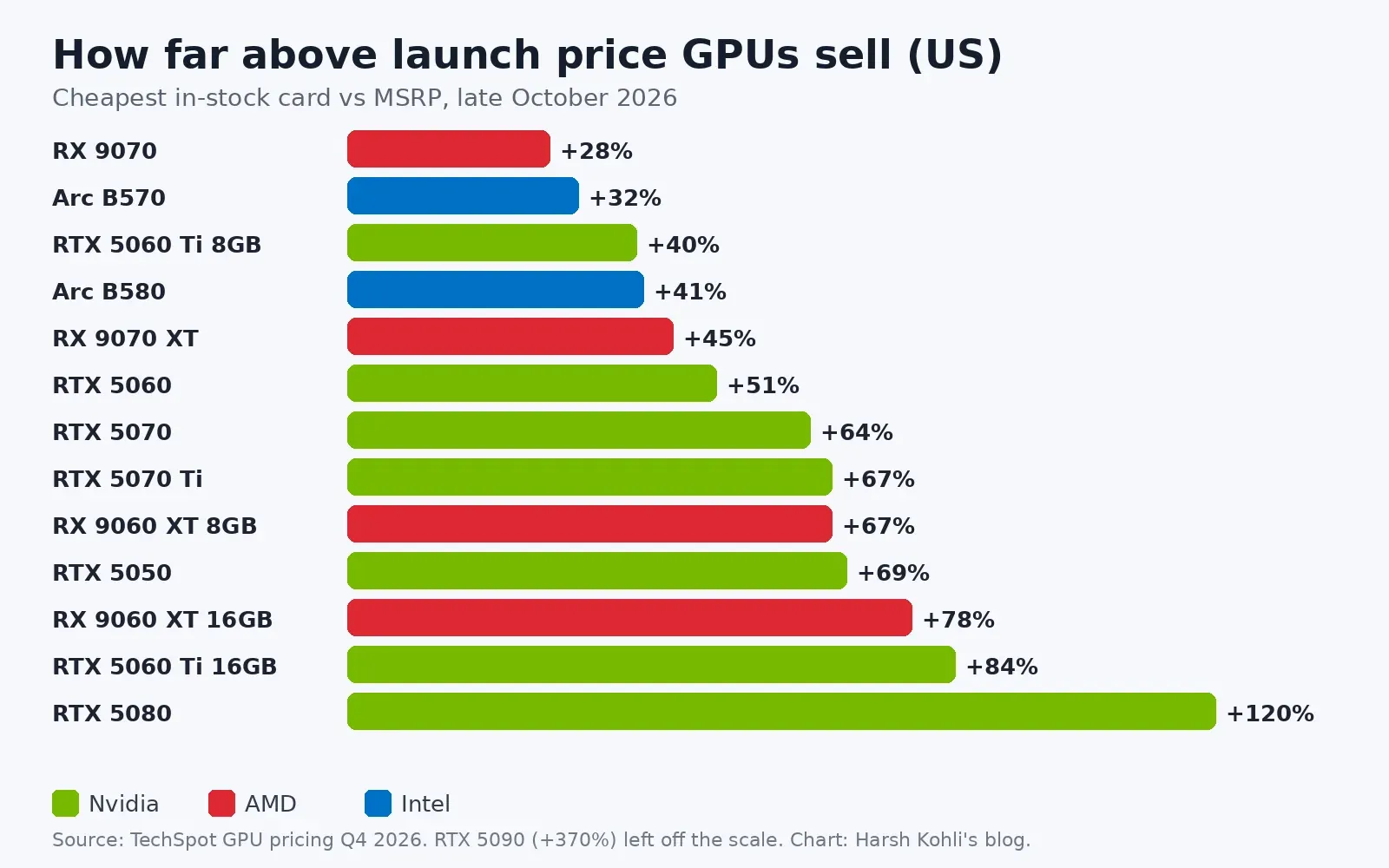
Put those together and you get what TechSpot measured: GPU prices up about 35% in three months, and around 44% above MSRP on average across the 10 countries it tracks.
Is anything new worth waiting for?
This is usually the best argument for waiting: a new generation arrives and the old cards get cheaper. Right now, that argument is weak.
- RTX 5080 24GB: it was rumoured for January 2027. Then this week, VideoCardz and HotHardware reported, citing China's Board Channels forum, that Nvidia had told its partners the January launch was off. The reason given was that 3GB GDDR7 chips cost about three times as much as 2GB ones. Nvidia never confirmed the card, so treat both reports as rumours.
- RTX 60 series and RDNA 5: the leaker Kepler_L2 says both are 2028 launches (via Notebookcheck), with one mid-to-high-end AMD chip (called AT2) possibly arriving in 2027. Other leakers have said 2027. Nobody official has said anything.
- Black Friday: it falls on 27 November this year. You might get a decent one-off deal. But prices went up, not down, in the two weeks before it. The cheapest RX 9070 on Amazon US went from $749.99 on 30 October to $859.99 on 11 November.
So "wait for the next generation" could mean waiting well over a year, at prices that may not have got any better. That's the honest picture. It's still fine to wait, as long as you're waiting because your current card is good enough, not because you expect a crash.
Step 1: Check whether your GPU is the problem
Before spending ₹1 lakh or $800 on a card, make sure the graphics card is actually what's holding you back. Plenty of stuttery gaming PCs are really short on RAM, running from a nearly full drive, or stuck behind a CPU that can't keep up.
- Start the game you care about and play for a few minutes.
- Turn on an overlay that shows GPU usage. In Steam, go to Settings > In Game > Performance Monitor. On Nvidia, the NVIDIA app overlay opens with Alt + Z. On AMD, Adrenalin's metrics overlay toggles with Ctrl + Shift + O. Or keep Task Manager's Performance > GPU tab open on a second screen.
- If GPU usage sits at 95-100% and frame rates are poor, the graphics card is the bottleneck. An upgrade will help.
- If GPU usage sits well below that (say 50-70%) while one or more CPU threads are pinned, your processor is the limit. A faster card won't fix that.
- Also check dedicated VRAM use. If the game fills your card's memory and stutters, the bigger fix is more VRAM, not just a faster chip.
If storage is the weak spot, my NVMe vs SATA SSD guide covers what actually changes in games when you upgrade a drive. It's a much cheaper fix than a GPU.
Step 2: Find your tier: buy or wait
Here's how I'd think about it at today's prices, tier by tier.
Budget, 1080p (launch prices around $250-$300): the 8GB cards (RTX 5060, RX 9060 XT 8GB) have held up best, but 8GB is tight for some new games at high settings. The Arc B580 gives you 12GB and is close in price. Buy now if you need a card. The gap to launch prices here is smaller in dollars than at any other tier, and waiting is unlikely to save much.
Mid-range, 1440p (launch prices around $550-$600): this tier gives the most room for a sensible choice. TechSpot measured the RX 9070 at about 27-28% over MSRP, one of the lowest markups of any current card it tracks. The RTX 5070 is cheaper in places but has only 12GB. If you need to buy in this tier, the RX 9070 is the card I'd look at first. If you're on something like an RTX 3070 or RX 6700 XT that still copes, wait.
16GB mid-range (RTX 5060 Ti 16GB, RX 9060 XT 16GB): these are the worst value right now. The RTX 5060 Ti 16GB sells for 84% over its launch price in the US. If you need 16GB, the RX 9070 often costs only a bit more and is a much faster card.
High end (RTX 5070 Ti, RTX 5080, RX 9070 XT): wait if you possibly can. These carry the biggest markups in raw money, and an RTX 5080 at roughly double its launch price is very hard to justify for gaming. The RX 9070 XT is the least painful of the three.
Under $250 or ₹30,000: there's barely anything new and current at this price. Older cards are the realistic option. The videocardprices.com index shows a few last-generation cards, like the RX 6600 and RTX 3070, listed below their original launch prices this week. Just check the listing condition and warranty before you buy.
Step 3: If you're buying, dodge the worst markups
- Price the exact model, not just the GPU. The cheapest RTX 5070 and a premium ROG Strix model can be tens of thousands of rupees or hundreds of dollars apart. Base models from Gigabyte, MSI, ASUS (Dual/Prime), Zotac, PNY or Sapphire perform within a few percent of the fancy ones.
- Avoid marketplace sellers if you can. Several of the highest US prices on ComputingForGeeks' list came from third-party sellers. Buying from the store itself, or a known hardware shop, makes returns and warranty claims simpler.
- Set a target and use a price tracker. In the US, ComputingForGeeks lists a "good Black Friday price" for each card. For example, it puts $739 as a good deal on an RX 9070 and $849 on an RTX 5070. In India, gpuprix and GPU Tracker keep price histories, so you can see whether today's price is a spike.
- Don't pay extra for VRAM you won't use. Playing esports titles at 1080p? An 8GB card is fine, and that's where the markups are smallest.
- Check the power supply first. A new card you then can't power properly is an expensive mistake. Look up the board power and recommended PSU on the maker's spec page before checking out.
Step 4: If you're waiting, get more from your current card
- Turn on upscaling. DLSS on Nvidia RTX cards and FSR on almost anything (including older GTX and Radeon cards) can buy back a lot of frames at a small cost in sharpness. On "Quality" mode the difference is hard to spot at 1440p.
- Drop the settings that cost the most. Ray tracing, ultra shadows and volumetric fog are the usual culprits. Texture quality mostly depends on VRAM, so leave it high if you have the memory.
- Update drivers, but don't chase every release. If a new driver breaks things, roll back. I've covered one case like that in Steam crashing on launch with AMD Radeon.
- Clean the card and check temperatures. A dusty cooler can make a GPU throttle. Compressed air and a fresh fan curve are free.
My take
I'd love to say "hold on until January, prices will settle". I can't find any evidence for it. Every tracker I checked shows prices still rising into November. The memory makers aren't promising relief before 2028, and the next generation of cards looks a long way off. So I wouldn't plan around a drop.
What I would do is separate need from want. If your card works, keep it, use the tweaks above, and check prices again in a few months. If you have to buy, the 8GB budget cards and the RX 9070 are where your money goes furthest right now. Stay away from the 16GB RTX 5060 Ti and the RTX 5080 at these prices unless you have a very specific reason.
Related guides: for more on fixing performance before you spend money, see my main guide to fixing high ping and lag in online games, since a lot of "my PC is slow" in multiplayer is really the network. If you're thinking of skipping a desktop GPU altogether, my Steam Deck vs ROG Xbox Ally X vs Legion Go S comparison covers the handheld route. Building the whole PC from scratch? See my budget PC build for 2026, which pairs these cards with the cheapest sensible platform.
FAQ
Will GPU prices go down in 2027?
There's no sign of it yet. Prices rose every month from August to November 2026. Memory, the main cause, is expected to stay tight through 2027. New GPU generations from Nvidia and AMD are rumoured for 2028, with possibly one AMD card in 2027. A flat stretch is possible; a big drop looks unlikely.
Is it worth waiting for Black Friday 2026 to buy a GPU?
Only if you can wait two weeks anyway. Black Friday is 27 November. Individual deals may show up, but prices climbed in the run-up. The cheapest RX 9070 on Amazon US rose from $749.99 to $859.99 between 30 October and 11 November. Set a target price before the sales start, and buy only if a card hits it.
Why are 16GB graphics cards so expensive?
Because video memory is the part that got expensive. The RTX 5060 Ti launched with a $50 gap between its 8GB and 16GB versions. On Amazon US in November that gap was $300. Cards with more memory carry more of the shortage's cost.
Which graphics card is the best value right now?
Going by markup, the RX 9070. TechSpot found it one of the least inflated current cards, about 27-28% over its $549 launch price. In this week's listings it sells for around $700 to $860 in the US and about ₹87,000 in India. At the budget end, the 8GB RTX 5060 and RX 9060 XT have risen less in actual money than the 16GB cards.
Is the RTX 5080 24GB coming out?
Not in January 2027, according to reports this week that cite China's Board Channels forum. Nvidia reportedly told partners the launch was cancelled because 3GB GDDR7 chips are too expensive. Nvidia never officially announced the card, so this is still a rumour.
Bought a graphics card recently? Tell me in the comments what you paid, which card, and in which country. Real prices from readers help everyone else work out what a fair deal looks like right now.

Comments ()