Should You Wait for RAM Prices to Drop? (2026)
RAM prices are still rising, just slower. Today's DDR5 and DDR4 prices in USD and INR, when relief might come, and whether to buy now or wait.
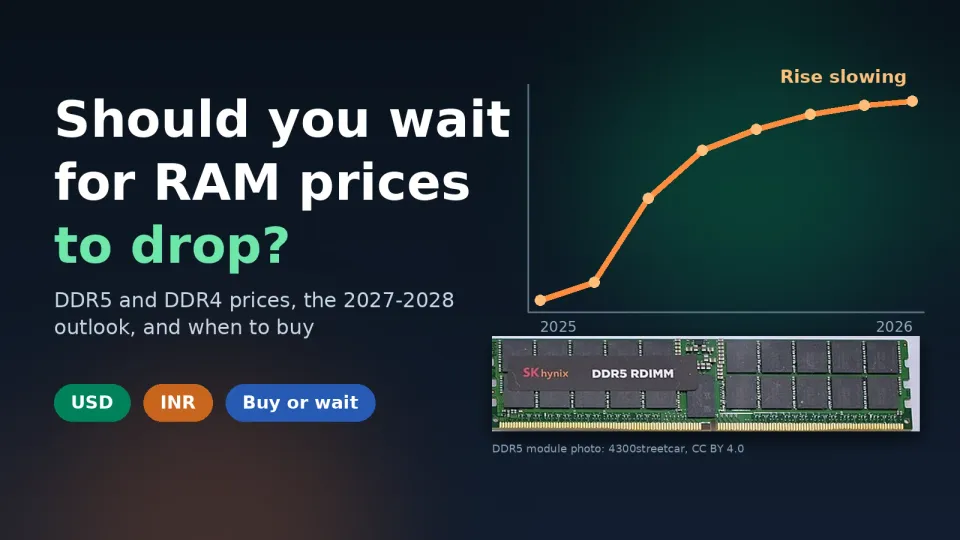
Updated: 12 November 2026. Prices checked this morning on rams.live (US store prices), MemRadar, pcbuildcost.in and PriceRig (Indian stores). Outlook from TrendForce's 11 November memory report and its rundown of new fab timelines.
Short answer: if you need RAM now, buy it now. Waiting for a real price drop probably means waiting until 2028. The price rises are getting smaller, but TrendForce still expects PC memory to cost more this quarter than last. The big new factories that could actually push prices down don't produce much before late 2028. The exceptions are simple. If your PC works fine today, there's no reason to panic-buy. And if you're on DDR4, prices on that older memory have started to slip.
I'm not going to pretend I know where prices will be next spring. Nobody does, and the analysts have been wrong in both directions. What I can do is lay out the numbers as they stand today, what the memory makers themselves are saying, and a simple way to decide based on what you've actually got.
Jump to:
- What RAM costs right now
- Why RAM got so expensive
- When could RAM prices actually fall?
- Step 1: Check whether you really need more RAM
- Step 2: Find your situation: buy or wait
- Step 3: If you're buying, spend less
- Step 4: If you're waiting, make what you have go further
- My take
- FAQ
What RAM costs right now
For anyone who last bought memory in 2025, today's prices are hard to believe. MemRadar tracks the Crucial Pro 32GB DDR5-6400 kit. Its lowest recorded price was $174.99 in October 2025. On Amazon it now sits at $628.96. That's one kit, but the whole market moved the same way.
Here's what stores are asking this week. US figures are what stores charge when they sell the kit themselves (no marketplace sellers), as read by rams.live on 12 November. Indian prices are the lowest in-stock listings I could find on Indian price trackers and store pages, GST included.
| Memory | US: typical price | US: cheapest | India: example in stock |
|---|---|---|---|
| 32GB DDR5 kit (2x16GB) | $569.99 | $379.99 (Crucial Pro 6400 CL38) | ₹60,160 (Corsair Vengeance 6000 CL36, MD Computers) |
| 32GB DDR5 single stick | n/a | n/a | ₹47,990 (G.Skill Ripjaws S5 5200 CL40) |
| 64GB DDR5 kit (2x32GB) | $1,299.99 | $799.99 | n/a |
| 32GB DDR4 kit (2x16GB) | $258.99 | $184.00 | n/a |
| 16GB DDR4 stick (3200) | n/a | $98.00 (Samsung) | ₹8,999 (SK hynix), ₹11,699 (G.Skill Aegis CL16) |
| DDR5, price per GB | $18.75 (up 3.4% in a week) | $11.87 | n/a |
| DDR4, price per GB | $8.31 (down 11.3% in a week) | $3.50 | n/a |
Two things jump out. DDR5 is still climbing week to week, and DDR4 has started to drift the other way. One week of data doesn't make a trend, but it fits with everything else in this post. Prices change daily, so check before you pay.
Why RAM got so expensive
The short version is AI servers. The three companies that make almost all of the world's DRAM (Samsung, SK hynix and Micron) have been moving factory capacity to server memory and HBM, the stacked memory that sits next to AI chips. That's where the money is, and it leaves less for the ordinary DDR4 and DDR5 that goes into PCs and laptops.
TrendForce publishes a forecast each quarter for what PC makers and other big buyers will pay for regular DRAM under their supply contracts. In 2026 those forecasts went like this:
- Q1 2026: up 90-95% on the previous quarter
- Q2 2026: up 58-63%
- Q3 2026: up 13-18%
- Q4 2026: up 10-15% for conventional DRAM, and 13-18% for PC DRAM specifically
(That history comes from TrendForce's press releases, collected on VLSI Korea's tracker. These are contract prices, not shop prices, but shop prices follow them.)
Read that list carefully. Prices aren't falling. They're rising more slowly. A 10-15% rise on top of a near-doubling is still a rise. That's the part a lot of "RAM prices are finally cooling" headlines skip over.
When could RAM prices actually fall?
Prices only really come down when supply catches up, and that needs new factories. Going by the timelines TrendForce collected in October:
- Micron brings its Idaho ID1 DRAM fab and the Tongluo fab it bought from PSMC online around mid-2027. Its next big wave, including Idaho ID2 and a Japan expansion, is slated for the second half of 2028.
- SK hynix pulled the first cleanroom at its Yongin Y1 fab forward to February 2027. Its later projects run into 2028 and 2029.
- Samsung is aiming to start its Pyeongtaek P5 fab in 2028, with its first Yongin fab targeted for 2029.
The companies themselves aren't promising relief either. Micron's CEO said on 30 September that supply could get tighter in fiscal 2027 and 2028 than it is in 2026. SK hynix's CEO has said the shortage could last until 2030. And TrendForce reports that memory makers are tentatively planning to cut PC DRAM supply in 2027 to make room for AI demand.
There is one thing pulling the other way. In the same 11 November report, TrendForce says laptop shipments fell 15.8% quarter on quarter in Q3 2026. PC makers bought memory early, sales are slow, and their inventories are piling up. Some are already renegotiating their 2027 orders. Weak demand like that is usually how a price surge starts to run out of steam. It's the reason I'd expect the rises to keep shrinking. It isn't a reason to expect prices to fall off a cliff.
Put it together and the honest forecast looks like this: smaller rises into 2027, maybe a flat patch, and a real drop only once new fabs are running in volume, most likely late 2028 or later. If you're holding out for 2025 prices, you could be waiting years.
Step 1: Check whether you really need more RAM
Before you spend anything at these prices, check whether memory is actually your bottleneck. Plenty of slow PCs are slow because of a full drive, a hot CPU or a browser with 60 tabs open, not because they need more RAM.
- Windows: press Ctrl + Shift + Esc to open Task Manager, go to Performance > Memory, and use your PC the way you normally do for a while. If "In use" stays near the total and things stutter, more RAM will help. This screen also shows your memory speed, how many slots are used (for example "2 of 4") and the form factor (DIMM for desktops, SODIMM for laptops).
- Mac: open Activity Monitor and look at the Memory Pressure graph on the Memory tab. Green means you're fine, even if "Memory Used" looks high. Most current Macs can't be upgraded anyway, so this matters more for your next purchase.
- Laptops: check whether your memory is soldered before you shop. Lots of thin laptops have no free slot at all.
If you're sitting at 50-60% use with 16GB, you don't need more RAM right now, whatever the price does.
Step 2: Find your situation: buy or wait
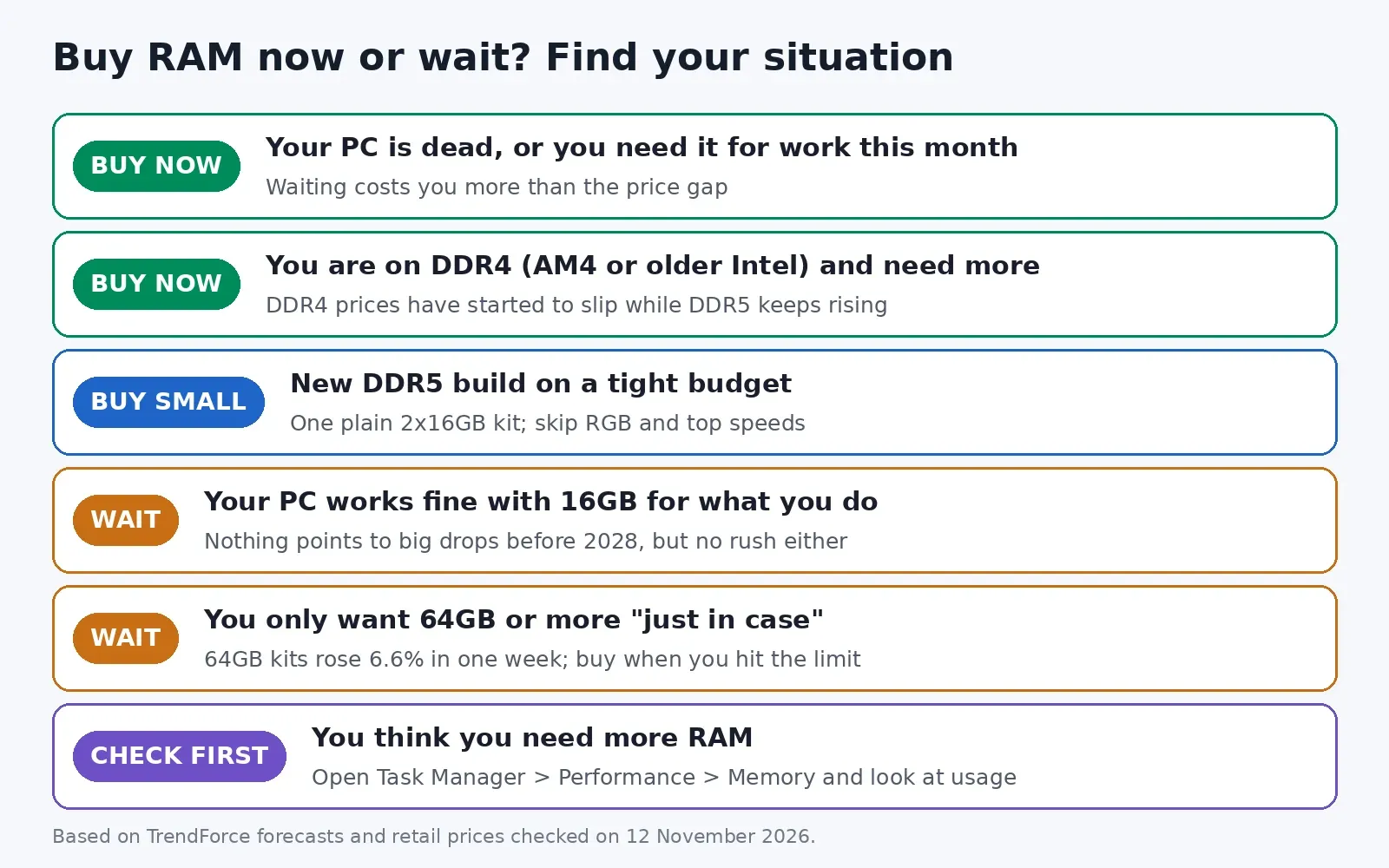
Buy now if:
- Your PC is broken or you need it for work or study this month. A few months without a working machine costs more than whatever you might save.
- You're on DDR4 (an AM4 board, or an older Intel board) and you really need more memory. DDR4 is the one type that has started to get cheaper, and it's still well under half the price per GB of DDR5.
- You're building a new PC anyway. Nothing in the forecasts points to DDR5 getting cheaper in the next few months, so delaying a build for RAM alone doesn't make much sense.
Wait if:
- Your PC runs fine and you just like the idea of more headroom.
- You want 64GB or more "for later". Big kits are the worst value right now. In the US, 64GB DDR5 kits went up 6.6% in a single week.
- You're only upgrading because a game listed 32GB under "recommended". Check Task Manager while you play first. Plenty of games run fine on 16GB.
Step 3: If you're buying, spend less
A few things make a real difference at today's prices:
- Skip the RGB and the fancy speeds. A plain DDR5-6000 kit is enough for most gaming PCs. RGB kits and very fast kits often cost far more. In India, I found 32GB 6000 kits ranging from about ₹53,500 to ₹65,000 depending mostly on brand and lighting.
- Buy two sticks, not one. Two 16GB sticks run in dual channel, which matters for gaming and integrated graphics. A single 32GB stick is often cheaper in India, but you lose that unless you add a matching second stick later, and matching it later isn't guaranteed.
- Don't plan to fill four slots later. On DDR5, four sticks usually run at lower speeds than two and can be fussier about stability. If you'll want 64GB eventually, it's better to buy a 2x32GB kit once you need it than to stack a second 2x16GB kit on top.
- Buy from the store, not a marketplace seller. Stick to listings sold by the retailer or the brand's official store, where returns and warranty are straightforward. At these prices, fake and relabelled memory is worth worrying about.
- If you buy used, test it. Run Windows Memory Diagnostic (type
mdschedin the Start menu) or the free MemTest86 before the return window closes. - Track the price for a week or two. Even in a rising market, individual kits drop. rams.live counted 12 genuine price drops in the week to 11 November, including a Kingston Fury Beast 32GB DDR5-6000 kit that went from $696.99 to $529.99 at Micro Center.
If your new build also needs storage, flash prices are under pressure as well, so read NVMe vs SATA SSD for gaming before you pay extra for a drive you don't need.
Step 4: If you're waiting, make what you have go further
If you've decided to hold off, you can get a good chunk of the benefit of more RAM for free:
- Your browser is usually the biggest memory user. My guide to fixing Chrome using too much memory covers Memory Saver, extensions and the tab habits that matter.
- Check startup apps in Task Manager (the Startup apps tab) and turn off anything you don't need running all day.
- Close launchers you aren't using, like Steam, Epic and the rest, before you play a game.
- Keep at least 15-20% of your system drive free so Windows has room for its page file when RAM runs short.
If games feel choppy, it may not be memory at all. My guide to fixing high ping and lag in online games covers the network side, which gets blamed on hardware all the time.
My take
I'd stop treating this as a short spike that's about to end. The people who make the chips are telling investors supply stays tight through 2028, and they're shifting capacity away from PC memory, not towards it. My advice is simple: buy what you need, when you need it, at a sensible spec, and don't buy extra "while it's cheap" because it isn't cheap. If your current setup works, keep using it and check prices again around January, when TrendForce's first forecast for 2027 should be out.
Related guides: the memory shortage is already hitting laptops and CPUs too. See Intel's Wildcat Lake chips selling out because of the shortage. And if you've got a low-RAM PC and want to try local AI, see the best Ollama models for 8GB RAM. Graphics cards are caught in the same shortage, so if you're also eyeing a GPU, see whether to buy a GPU now or wait. Planning a whole new PC around these prices? My budget PC build for 2026 prices out an AM4 and DDR4 parts list in USD and INR.
FAQ
Will RAM prices go down in 2027?
Probably not by much. TrendForce still expects rises in late 2026, only smaller ones. Memory makers plan to cut PC DRAM supply in 2027, and most new fab capacity doesn't arrive until the second half of 2028. Smaller increases or a flat stretch in 2027 look more likely than a real drop.
Why is RAM so expensive right now?
Samsung, SK hynix and Micron have moved production to server memory and HBM for AI data centres. That leaves less regular DDR4 and DDR5 for PCs. Contract prices nearly doubled in Q1 2026 alone, and shop prices followed.
Is DDR4 getting cheaper?
It's started to. In US stores, the typical DDR4 price per GB fell 11.3% in the week to 12 November, while DDR5 rose 3.4%. A 16GB DDR4-3200 stick starts around $98 in the US and about ₹9,000 to ₹11,700 in India. It's worth it if your board is DDR4. It isn't a reason to choose a DDR4 platform for a brand-new build.
How much does 32GB of DDR5 cost now?
In the US, the typical 32GB DDR5 kit is about $570 and the cheapest in-stock kit is about $380 (as of 12 November 2026). In India, 2x16GB DDR5-6000 kits I found ran from about ₹58,700 to ₹65,000, and single 32GB sticks start near ₹48,000.
Is 16GB of RAM still enough?
For browsing, office work and most games, yes. Check Task Manager while you do your normal work. If usage stays well under the total and nothing stutters, upgrading now just means paying peak prices for headroom you don't use.
Bought RAM recently, or found a better price than the ones here? Tell me in the comments what you paid, where, and in which country. It helps other readers work out what counts as a fair price right now.

Comments ()