2 Billion Stolen Logins Left Open Online: What to Do
An open database held about 2 billion stolen logins, plus cookies and session tokens from infostealer malware. Who's at risk and what to do now.
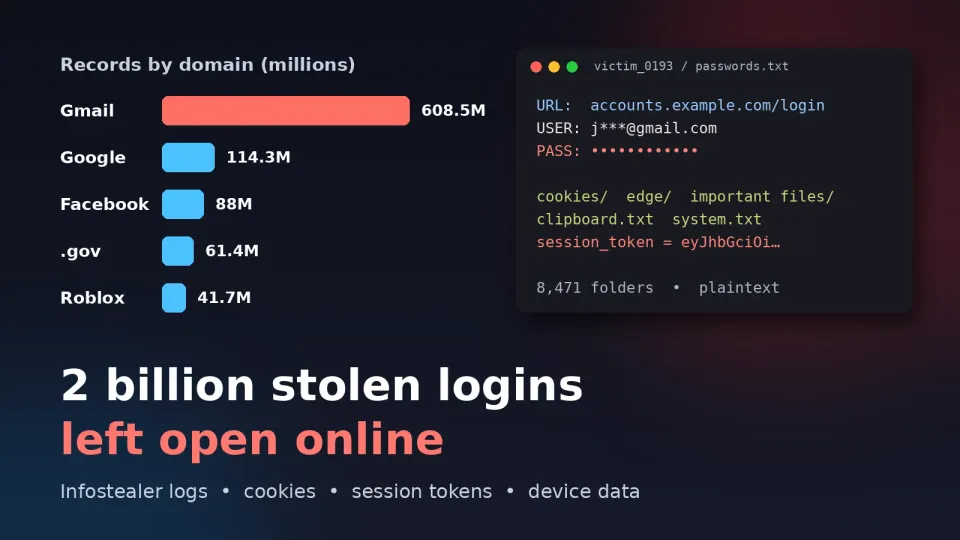
Someone left about 2 billion stolen logins on an open server. No password, no encryption, just sitting there. Yes, we've seen "billions of passwords" headlines before, but this pile is worse than most because a big chunk came from infostealer malware. So it's not only old email and password combos. There are browser cookies, session tokens and device info in there too, and those can get a person into your account even if you've got two-factor turned on.
What happened
Jeremiah Fowler, a longtime breach hunter who now works at Black Hills Information Security, published his findings on November 24 in a report shared with ExpressVPN. He says the exposed storage held about 2 billion credential records spread across 8,471 folders, all in plaintext. Some files were split by country code (US, UK, FR, DE and more). About 400,000 documents came from what he calls more advanced malware that built a separate folder per victim, with subfolders for cookies, applications, the Edge browser and "important files", plus text files for clipboard contents, running processes and saved passwords.
He also spotted thousands of logins for Tor .onion sites, which he says is the first time he has seen dark web accounts in a credential dump at this scale. WIRED, which covered the find alongside a separate, unrelated 1.6 billion-record trove of mostly China-linked data, says Fowler couldn't work out who owned the database (9to5Mac also covered it). He reported it to the hosting company, and public access was cut off several days later. Nobody knows how long it was open or who else found it.
Fowler didn't download the files. He ran searches for common domains while the data was reachable, and those line counts give a rough picture:
| Service or domain | Approx. matching records |
|---|---|
| Gmail addresses | 608.5 million |
| Google services logins | 114.3 million |
| 88 million | |
| .gov email addresses | 61.4 million |
| .org / .edu email addresses | 49.9 million / 46.3 million |
| Yahoo | 42.2 million |
| Roblox | 41.7 million |
| Amazon | 36.6 million |
| X (x.com) | 32.9 million |
| 31.1 million | |
| PayPal / iCloud / Microsoft | 15.2 million / 15 million / 12.9 million |
| Binance / Coinbase | 1.7 million / 1.5 million |
Those are estimates and they include duplicates. Fowler is clear that 2 billion records does not mean 2 billion victims: one infected laptop can produce dozens of entries, and infostealer data gets copied and resold over and over.
Why it matters
An infostealer is malware that grabs whatever your browser and apps have stored, usually after you run a cracked game, a fake installer or a booby-trapped attachment. The problem is the cookies. A stolen session cookie can let someone open your account as if they were already signed in, without your password or your 2FA code. That's why Fowler's line to WIRED about the per-victim folders stuck with me: if you had that, you "own that person".
Branded Telegram channels and country-split files hint at the usual trade in stolen logs sorted by region, though Fowler says it could also have been a research collection. Nobody knows yet.
What to do
- Check your email on Have I Been Pwned. This exact database isn't confirmed to be loaded there, but a hit from any older leak tells you which passwords are already out.
- Change any password you've reused, starting with your main email, since that's the key to resetting everything else. A password manager makes unique passwords painless.
- Sign out of all sessions on Google, Microsoft, Apple, Meta and your bank. Changing a password doesn't always kill an existing session; the "sign out everywhere" option does.
- Move to passkeys or an authenticator app instead of SMS codes where you can.
- If anything looks off, clean the device first. Fowler's advice is that new passwords typed on an infected PC just get stolen again, so scan or reset it, then change passwords from a clean device.
- In the US, freeze your credit with Equifax, Experian and TransUnion. It's free and takes a few minutes each. Elsewhere, check whether your credit bureau offers a freeze or alert.
My take
My first reaction to "2 billion credentials" was a shrug. We get one of these every few months, and Fowler himself found 184 million records last year and 149 million in January. What changed my mind is the shape of the data. The January dump was mostly usernames, passwords and login URLs. This one has cookies and whole per-device folders, and that's the part that beats the advice we've all been repeating for years. 2FA is great against someone holding your password. It does very little against someone holding your live session.
So who's actually at risk? Mostly people whose PC got infected at some point, and gamers are a big slice of that. The Roblox and Discord numbers don't surprise me at all. Free "mod menus", cheats and cracked games are the classic way stealers land on a machine, the same way the fake PS5 emulators on GitHub did. If you or your kid has run something sketchy in the past year or two, assume the browser data walked out the door.
What I'd do tonight: run a proper malware scan (the persistence and session steps in my NIKKE launcher malware check apply to any Windows PC), then hit "sign out of all devices" on your Google or Microsoft account and change that password from your phone. After that, set up a passkey for your main email. It takes two minutes, and a passkey can't be typed into a phishing page or scraped from a text file the way a password can.
One more thing. Leaks like this feed the scam emails that follow, the same pattern I covered with the Chase, Visa and Mastercard vendor leak this week. If you get a "your account was in a breach, verify here" message in the next few days, don't click it. Go to the service yourself.

Comments ()