Binance Details Fake Job Path to $6.43B Theft
Binance post-mortem: trojanized Homebrew, fake interviews, internal AI abuse led to the Oct 29 wallet signing theft. Not simple phishing.
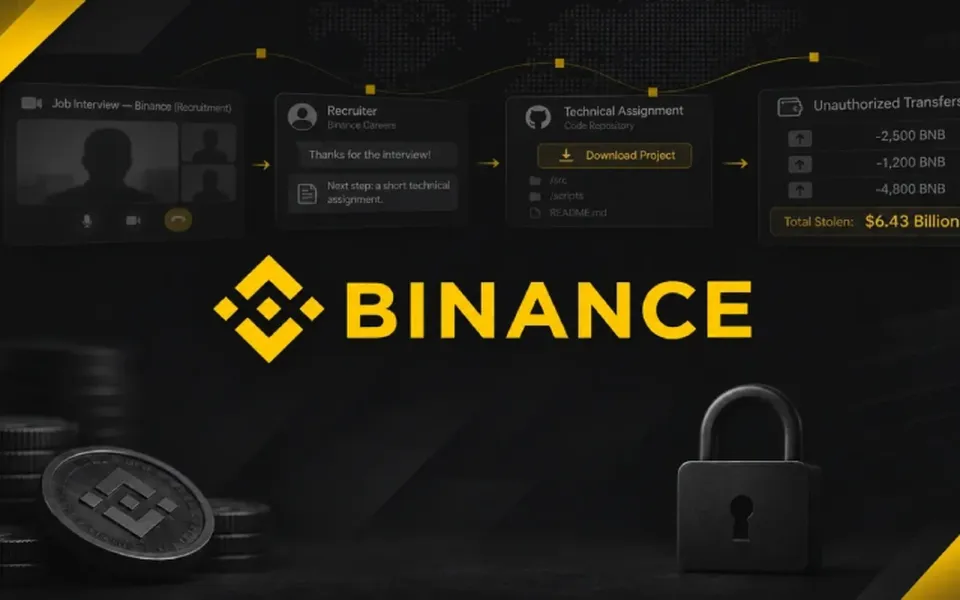
Binance just published the how, not just the dollar figure. The October 29 drain of about $6.43 billion (~₹61,000 crore at ~₹95/$) was not a one-click phishing hit. It was a months-long campaign that mixed a trojanized Homebrew install, fake job interviews, malware on a work Mac, and abuse of an internal AI tool before the attackers reached a wallet signing service.
What happened
According to Binance's own incident write-up, covered in detail by The Hacker News and BleepingComputer, the path started in June 2026. A Wallet DevOps engineer ("Engineer A") searched for a popular AI tool, downloaded a tampered Homebrew installer, and got hit. Security caught that stage, rotated credentials, and replaced the device — but the attackers still walked away with intel on that engineer and wallet-team colleagues.
In September, another engineer ("Engineer B") got a message on a real job platform from someone posing as a Project Director. Two interviews followed: a live video call with a fake HR person who shared a social account full of personal photos to look legit, then a second round on a chat app with someone claiming to be CEO of a company that did not exist. Near the end, Engineer B was told to pull down a coding "assignment" onto a work computer. That repo ran malware during setup, swapped a real Homebrew pyenv binary for a poisoned one, and phoned home.
From October 20 the attackers used Engineer B's machine and an internal AI tool to reach Engineer A and Wallet Software Engineer C, then found a container deployment token. On October 29 between 17:15 and 19:56 they logged onto C's machine, reused stolen credentials, deployed a container, and triggered a script that abused the wallet signing service for unauthorized transfers. Binance says this was not a simple private-key leak. @TheHackersNews summarized the chain on X; BleepingComputer also posted the same day.
As of November 3 Binance says entry points are closed, devices replaced, credentials revoked, and wallet systems plus the internal AI tool rebuilt. BleepingComputer adds that about $2.85 billion in stolen assets had been frozen or intercepted. The FBI had already tied the theft to North Korea's TraderTraitor / Lazarus cluster.
Why it matters
Fake "coding assignments" and recruiter theater are now a standard playbook against crypto and DevOps staff — Contagious Interview and Operation Dream Job have been doing variants for years. What stands out here is the patient pivot through an internal AI tool and a signing service after the first June infection was supposedly cleaned. If you only train people on obvious phishing links, you will miss this. I covered the initial pause and suspected theft size in our earlier Binance hack note; this post-mortem is the missing attack path.
What to do
- Never install interview "assignments," Homebrew formulas, or AI tooling on a machine that holds wallet, signing, or deploy tokens. Use a locked-down personal laptop for recruiting homework.
- Treat internal AI assistants like any other privileged service: short-lived credentials, no lateral reach into wallet infra, and logs you actually review.
- If you hold crypto on exchanges, keep long-term bags on hardware you control — the same caution we flagged after the Trezor reseller implant warning.
- Read Binance's own report and the THN / BleepingComputer write-ups before repeating secondhand numbers; the investigation is still open to independent review.
Comments ()